Over the past 1 and a half years, I was involved in designing and developing a multi-tenant Treasury Management system. In this article, I will share our approaches to the data isolation aspect of our multi-tenant solution and the learnings from it.
Background & problem regarding Data isolation
Before going into the problem which I am going to focus on today, I must give some background into our architecture for storage and data in our system first. When it comes to data partitioning for SaaS systems, at the extreme far right end, we have the approach of using dedicated databases for each tenant (silo model) and on the other side of the spectrum is the shared database model (pool model).

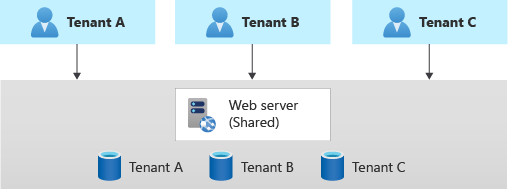
Image source – https://learn.microsoft.com/en-us/azure/architecture/guide/multitenant/approaches/storage-data
For obvious reasons such as reduced management overhead and lower cost, it was decided that our solution would be in the shared database model and with that comes the drawback of lower levels of inherent data isolation. In most cases with the shared database model, the data isolation depends on developers implementing the correct WHERE clauses in every SQL statement but this is of course error prone. We wanted an approach to enforce the data isolation from a separate layer and in comes the concept of Row Level Security (RLS).
interface TransactionRepository : JpaRepository<Transaction, Long> {

    // trivial approach
    fun findAllByTenantId(): List<Transaction>

    // what we want to achieve
    override fun findAll(): List<Transaction>
}
Trivial Approach vs Expected Approach for Spring Repository Method Calls
Solution – ROW Level Security (RLS)
In general terms, Row Level Security (in RDBMS) refers to mechanisms that allow controlling access to rows in a database table based on some context (example tenant_id). To my knowledge, this feature has been around on PostgreSQL DB since 2020 and this is available in SQL Server, in Amazon Aurora for PostgreSQL and RDS for PostgreSQL at the time of writing.
ALTER TABLE gtms_payment.TRANSACTION ENABLE ROW LEVEL SECURITY;
CREATE POLICY tenant_isolation_policy ON gtms_payment.TRANSACTION
    USING (business_group_code = current_setting('app.current_tenant')::VARCHAR);
A sample RLS policy on PostgreSQL
Other Solutions – SpRing Post Filter, Hibernate FILTERS with SPRING ASPECTS
To give more details from my analysis of the possible solutions, let me share some brief info on other possible approaches as well. One of the options was Spring PostFilter but that would mean all data (across multiple tenants) will be returned to the backend from the db query before they are filtered and sent out and this was not ideal for our use case.
Another option (which is specific to our backend tech stack – Spring, Hibernate, and Java/Kotlin) was to use Hibernate Filters with a Spring Aspect. This option was quite good but not as strong as having the enforcement done on the DB layer. (We did use this approach to solve a similar use case and I hope to cover this in a later blog)
going ahead with RLS
Our standard database solution throughout the organization was PostgreSQL (for use cases like ours) and this helped in our decision to go ahead with RLS as the solution but if you are trying to solve a similar problem with RLS do take note that not all of the relational databases support Row Level Security yet so you might have to be aware of being locked into a subset of databases that support RLS. However, switching to another relational DB that supports RLS should not be too difficult as there is little dependency on the DB type on the code level itself when using RLS.
Implementation
Going into the implementation details, once RLS is enabled on the DB, we should set the parameters (in our case app.current_tenant) for the DB to run the policy on for each query. In our case, we do that on the DataSource implementation as follows. In our flow, we maintain the Tenant information on Spring Security Context (again which I hope to cover in a separate blog) and the getTenantId() which is abstracted out here is retrieving the Tenant Id from the Spring Security Context.
class TenantAwareHikariDataSource : HikariDataSource() {

    override fun getConnection(): Connection? {
        val connection = super.getConnection()
        return createConnection(connection)
    }

    override fun getConnection(username: String, password: String): Connection? {
        val connection = super.getConnection(username, password)
        return createConnection(connection)
    }

    private fun createConnection(connection: Connection): Connection? {
        connection.createStatement().use { sql ->
            sql.execute("SET app.current_tenant = '${getTenantId()}'")
        }
        return connection
    }
}
Tenant-aware Hikari Datasource
Note that if the parameters required for the RLS policy are not set, we will run into errors as follows.
[2024-08-25 22:53:50] [42704] ERROR: unrecognized configuration parameter "app.current_tenant"Supporting use cases That Does Not Require a tenant id
In all multi-tenant systems, there will always be some use cases such as tenant onboarding where you will have to run DB queries without a tenant id. So can we support such use cases? The answer is Yes!. In PostgreSQL functionality, the schema owner bypasses RLS policies. Hence in our solution we have, we maintain two sets of DB configs (Tenant DB Config and Non Tenant DB Config) and two sets of Spring Repositories tied to each DB config with Tenant Config as primary.
Thus in the few use cases that need to run queries without a Tenant Id, we use the Non-Tenant Configs. We do have to use PostgreSQL schema owner user for the database change management tool (in our case Liquibase) as well.
PROS and CONS of RLS Approach to Sum things up
PROS
- RLS provides data isolation on the DB layer hence it provides a stronger isolation than that of the common
WHEREclause approach. - Most of the data isolation logic (Tenant-aware data source, Tenant and Non-Tenant db configs etc) can be on a separate library and shared across different micro-services. Hence developers can worry less of tenant data isolation while developing application-level business logic
CONS
- Since not all relational databases support RLS yet, there will be a DB lock-in as explained in previous sections
Bonus
Though we have talked about how to use TenantId in TenantAwareHikariDataSource, we have not touched on how to set and reset TenantId. One of the ways to do this, specially in the case of REST API calls, is to use an Interceptor.
class TenantInfoInterceptor : HandlerInterceptor {
    override fun preHandle(request: HttpServletRequest, response: HttpServletResponse,
                           handler: Any): Boolean {
        // set TenantId
        return super.preHandle(request, response, handler)
    }

    override fun afterCompletion(request: HttpServletRequest, response: HttpServletResponse, handler: Any, ex: Exception?) {
        // reset TenantId
        super.afterCompletion(request, response, handler, ex)
    }
}
Furthermore, in cases of Async thread usage, we need a mechanism to pass the TenantId to async threads. A TaskDecorator is used for this purpose.
@Configuration
class AsyncConfiguration : AsyncConfigurer {
    override fun getAsyncExecutor(): TaskExecutor {
        val executor = ThreadPoolTaskExecutor()
        executor.maxPoolSize = 50
        executor.queueCapacity = 250
        executor.setThreadNamePrefix("ContextAwareTask-")
        executor.setWaitForTasksToCompleteOnShutdown(true)
        executor.setTaskDecorator(AsyncTaskDecorator())
        executor.initialize()
        return executor
    }
}

class AsyncTaskDecorator : TaskDecorator {
    override fun decorate(task: Runnable): Runnable {
        return Runnable {
            try {
                // set TenantId
                task.run()
            } finally {
                // reset TenantId
            }
        }
    }
}
Furthermore, in cases where events/messages are passed through from one service to another, we may have to rely on metadata from event (in our case AWS SQS message metadata) to set the TenantId if needed.
Hope you all have fun with RLS! 🙂
References
- https://aws.amazon.com/blogs/database/multi-tenant-data-isolation-with-postgresql-row-level-security/
- https://learn.microsoft.com/en-us/azure/architecture/guide/multitenant/approaches/storage-data
~ Rajind Ruparathna
Featured image credits: TheDigitalWay from Pixabay

 Notebook
One thought on “Multi-Tenant Data Isolation & Row Level Security”